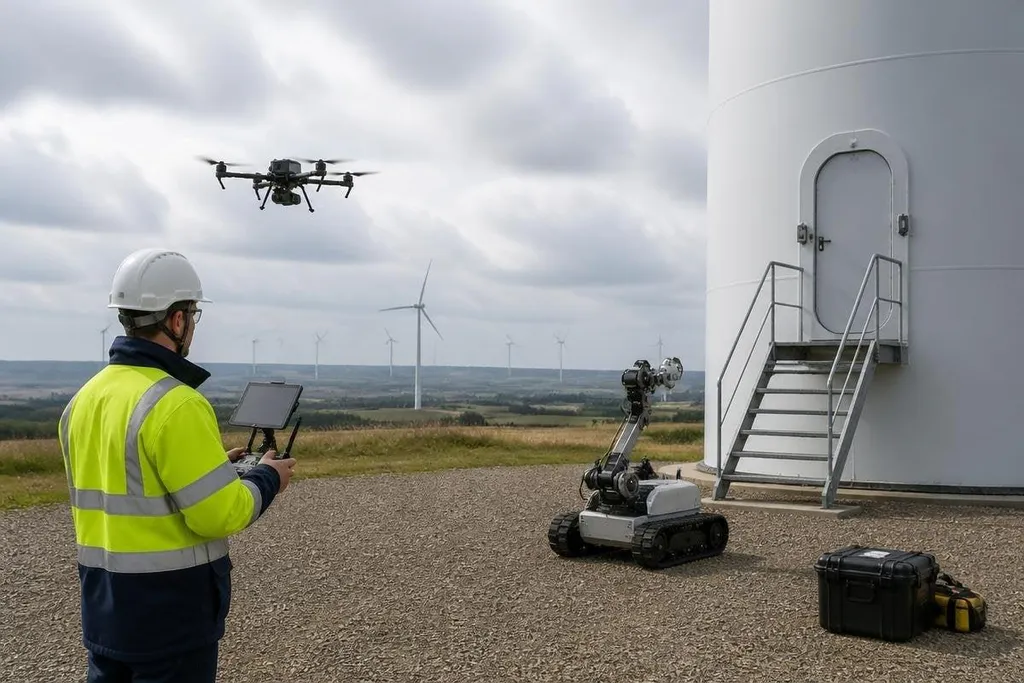
Wind turbines put workers high above the ground, where inspection and repair take time, equipment, and careful planning. Robots can create new businesses around those jobs, but the strongest opportunity may sit in repeatable services rather than robot sales.
- Inspection: collect blade, tower, and gearbox data without sending people into every work area.
- Maintenance: clean surfaces, remove damaged material, or support small repairs.
- Business model: sell scheduled service and useful reports instead of hardware alone.
Inspection creates the first sale
A turbine inspection can involve drones, cameras, LiDAR, climbing robots, or tools carried by a technician. Each system gathers a different kind of evidence, so the business must state what it can find and what a customer can do with the result.
A blade inspection service could record cracks, surface wear, lightning damage, or problems near the leading edge. The useful output is a dated report linked to the blade location, with images that let a maintenance team decide what to inspect next.
That creates room for several types of suppliers. A company might build the robot, run inspection visits, process images, or sell software that stores findings across many turbines.
The customer may care less about the robot than about finding damage early enough to plan a repair visit.
For a wind farm operator, a useful report names the turbine, inspection task, test date, weather, and recorded fault. A report from Robot 24 can tie those details to a robot’s field result before you pay for a trial, then separate inspection work from the machines needed for repair or cleaning.
Repair and cleaning need different machines
Inspection is easier to sell when the robot only needs to see and measure. Repair asks for force, accurate positioning, tool control, and a safe way to work against a curved blade or tower wall.
Cleaning may offer a simpler starting point. A robot could remove dirt, salt, or other deposits from a blade surface while a worker stays on the ground. The business still needs to show how the robot handles wind, moisture, cable movement, and changing surface conditions.
Small repair tasks could follow. A robot might carry a tool, hold a camera close to a damaged area, or apply material under remote supervision. That does not remove the need for skilled workers. It changes where they spend their time and may reduce the amount of rope work or climbing.
The open question is repeatability. A machine that works on one clean blade in calm weather may need more sensors, slower motion, or human control on a working wind farm.
Where the money may sit
Robot makers can sell equipment, but service contracts may give customers a lower-risk way to start. A wind farm operator could pay per turbine, per inspection, or per completed task, with the supplier handling transport, setup, maintenance, and data review.
Software is another route. Inspection records become more useful when a customer can compare the same blade over time, assign a repair, and check whether the repair changed the next inspection result. The software needs clear evidence, not a single score that hides uncertainty.
Training and support also matter. Field crews need procedures for launching a drone, checking a climbing robot, responding to a lost connection, and deciding when a human must take over. Companies that build those processes may earn revenue even when the robot comes from another maker.
I’d start with a service that removes one risky, repeated task and proves its value on a defined group of turbines.
A practical entry plan
Before building or buying a wind turbine robot, check these points:
- Name the task: state the surface, tool, defect, or measurement the robot must handle.
- Set the handoff: define when a technician takes control and what happens after a fault.
- Price the visit: include travel, setup, data review, repairs, insurance, and robot downtime.
- Test the report: make sure a maintenance team can act on each finding without guessing.
- Plan for weather: set limits for wind, rain, ice, temperature, and poor visibility.
A pilot should measure completed turbines, useful findings, human hours on site, repeat visits, and faults that stop the job. Those numbers show if the robot saves work or only moves it into setup and review.
Wind turbine robotics has a real business path when the machine handles a defined task, the report supports a maintenance decision, and the service price fits the work it replaces. The next useful proof is not another clean demo. It is a paid job repeated across enough turbines to show that the numbers hold.